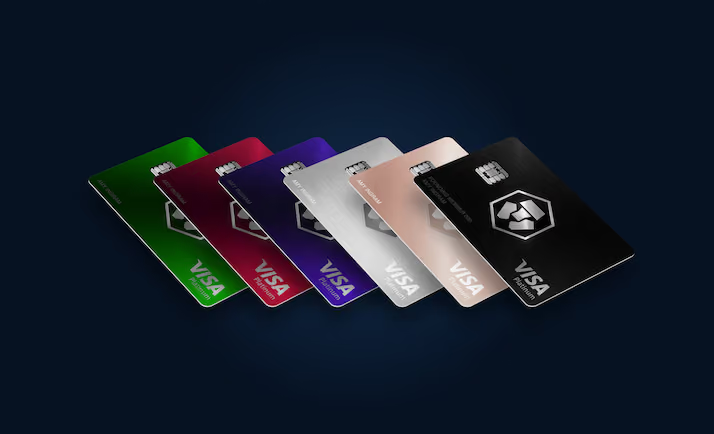
What the Tria crypto card actually is
It is a Visa card issued through a card programme, funded by crypto you still own. That sentence contains both the appeal and the risk.
When you pay, the merchant sees a normal Visa authorisation in local currency. Behind that, the card programme prices the transaction, your on-chain collateral is converted, and settlement happens through the card network. Tria states the card is backed 1:1 by the digital assets you hold and works across 150+ countries at 130M+ merchants, with 1,000+ tokens accepted as funding.
This is architecturally different from an exchange card, where the exchange already holds your coins and simply debits its internal ledger. Here the coins remain in your custody until a payment consumes them. The practical benefit is that a company failure does not, in principle, take your balance with it. The practical cost is that a conversion has to happen at the moment of payment, and the quality of that conversion is the real price of the card.
One point of confusion worth clearing up: some third-party write-ups describe Tria as offering both Visa and Mastercard products. Tria’s own marketing centres on Visa. When two sources disagree about something as basic as the network, treat every other number in the secondary source with the same caution.
The question that matters more than cashback
At the moment of a €40 payment, what exchange rate is applied and what spread sits inside it? A 6% cashback headline is worth less than a consistently tight conversion rate, because the spread applies to every transaction while the top cashback rate usually does not.
The three tiers, and what each one really asks of you
Tria lists Virtual, Signature and Premium products. The virtual card is the entry point: instant issuance, wallet-based payments through Apple Pay and Google Pay, and daily limits Tria quotes as reaching $1M. Signature is the standard physical card. Premium carries the highest advertised cashback and lifestyle benefits including airport lounge access and asset protection.
Widely circulated promo pages quote a tier ladder of roughly 1.5% on Virtual, 4.5% on Signature and 6% on Premium, each with its own monthly cap. Those numbers do not appear in that form on Tria’s own site, and they come from pages whose business is distributing referral codes. We are quoting them because you will see them everywhere — not because they are verified. Check the rate in the app against your own tier before assuming any of it.
The rational way to pick a tier is arithmetic, not aspiration. Multiply your realistic monthly card spend by the difference in cashback rate, then compare that with whatever the higher tier requires you to hold or pay. If the answer is a few euros a month, the higher tier is a lifestyle purchase, not a financial one.
- Break-even on issuance A one-off ~$20 fee at 1.5% cashback needs roughly $1,300 of spending to recover.
- Cap discipline A high rate with a low monthly cap behaves like a small fixed rebate. Model the cap, not the rate.
- Holding cost If a tier requires holding a volatile token, the token’s risk is part of the card’s price.
Fee anatomy: printed, hidden and structural
Three layers. Most reviews only count the first one, which is why crypto cards look cheaper on paper than in a bank statement.
Printed fees are the easy part. Independent card databases list Tria’s card with a one-off issuance fee of about $20, no monthly fee, no top-up fee, 0% foreign exchange fee, free ATM withdrawals and no decline fee. That is a competitive sheet — and it is third-party data about a fast-moving product, so treat it as a starting point for your own check rather than a promise.
Hidden costs live in conversion. A card payment in a currency you do not hold requires two conversions: your asset into a settlement currency, and that into the merchant’s currency. “0% FX fee” describes the absence of an explicit markup line, not the absence of a spread. The way to measure it is boring and effective: make a small purchase, note the exact amount debited, and compare it with the mid-market rate at that timestamp.
Structural costs are the ones nobody can remove. If you fund the card from a network with expensive settlement — Ethereum mainnet during congestion is the classic example — you pay that regardless of the card’s fee table. Funding from a low-cost network, or from stablecoins already sitting on a cheap chain, is the single biggest saving available to a normal user.
A fee test you can run in ten minutes
Load a small amount, buy something inexpensive in a foreign currency, and screenshot both the merchant total and the app’s transaction detail. Divide one by the other, compare against a public reference rate for the same minute, and you have the card’s real cost — not the advertised one.
- Good result Within about 0.3% of the reference rate. That is a genuinely cheap card.
- Acceptable 0.3% to 0.8%. Still competitive with most retail banks.
- Investigate Above 1%. The spread is now larger than most of the cashback you will earn.
Limits, KYC and who is excluded
Tria advertises daily spending limits up to $1M, which is a headline figure that few readers will ever test. The limits that matter in daily life are per-transaction ceilings, ATM caps, and how quickly a top-up becomes spendable.
The card requires identity verification. Third-party trackers describe the level as email, phone and an identity document, without proof of address or a selfie step at the time of writing. That is lighter than many exchanges, and it still creates a permanent link between your legal identity and the addresses you fund the card from. If on-chain privacy matters to you, use a separate address for card funding and understand that heuristics can still connect it to the rest of your activity.
Geography is the hard wall. Those same trackers list the card as unavailable to residents of the United States, China, India and Russia, while Tria markets US bank accounts as “coming soon”. Eligibility is set by the issuer and can change without notice in either direction. No promo code, VPN or referral link changes it, and attempting to work around it puts your funds at risk of being frozen during review.
Do not lie on an application
Supplying a false residence to obtain a card programme you are not eligible for is fraud against the issuer, and the usual consequence is that funds sit frozen while a compliance team decides what happens next. That is a worse outcome than not having the card.
Cashback: read the cap, not the percentage
Tria advertises up to 6% cashback on card purchases, and in 2026 shifted rewards toward stablecoin payouts rather than locked tokens. That change is a real improvement: a stablecoin rebate is money, while a locked token rebate is a promise whose value depends on a market you do not control.
The word doing the heavy lifting is still “up to”. In practice, high-rate crypto cashback is bounded by a monthly cap, restricted to eligible merchant categories, and tied to a tier that has its own requirement. A 6% rate on the first $500 of monthly spending is $30 — respectable, but a different product from “6% on everything”.
There is also a second-order effect people miss. Cashback paid in crypto is income in many jurisdictions at the moment of receipt, and then a separate disposal when you spend it. If you optimise hard for rewards, you also generate the most paperwork. Decide whether the rebate is worth the record-keeping before you chase a tier.
- Ask What is the monthly cap, in currency, at my tier?
- Ask Which merchant categories are excluded — utilities, transfers, gambling, crypto purchases?
- Ask Is the reward paid in a stablecoin, and when does it land?
The security controls to switch on the day it arrives
A crypto card carries the same fraud surface as any other card, plus one extra: the balance behind it is not protected by a bank’s dispute department in the way a current account is. Chargebacks exist through the card scheme, but recovery of a converted crypto balance is not guaranteed.
So compress the blast radius. Keep a spending balance rather than a savings balance behind the card. Enable instant freeze and learn where the button is before you need it. Turn on transaction notifications so an unexpected authorisation reaches you in seconds, not at the end of the month. Where the app supports per-merchant or per-region controls, use them.
Treat the virtual card as the default for online purchases and keep the physical card for in-person use. If a virtual number leaks, replacing it costs nothing; replacing a physical card costs time and, in most programmes, money.
If a payment goes wrong
Freeze the card first, then file the dispute through the app rather than contacting the merchant only. Keep the transaction hash of the corresponding on-chain movement: in a crypto card programme, that hash is the evidence that connects a card authorisation to the value that left your wallet.
Every coffee is a disposal
This is the part of crypto card ownership that surprises people a year later. In most tax systems, converting crypto to fiat is a disposal that realises a gain or a loss — and a card payment is a conversion. A hundred small purchases produce a hundred small disposals, each with its own cost basis.
Two habits make this survivable. First, fund the card from stablecoins rather than from appreciating assets: a stablecoin disposal produces a gain near zero, which keeps the calculation trivial. Second, export transactions monthly rather than annually, while you still remember what a payment was for.
None of this is tax advice; rules differ sharply between countries and change often. It is simply the operational reality of spending an asset that a tax authority treats as property.
How it compares with the alternatives
Against an exchange card, Tria’s advantage is custody: your coins are not sitting on a platform that can freeze them, and the conversion happens only at payment. The exchange card’s advantage is simplicity and a support desk that can actually intervene. Which matters more depends on whether you value control or recourse.
Against a normal bank card funded by a periodic manual sale of crypto, the crypto card wins on convenience and loses on record-keeping. Selling once a month on an exchange and spending fiat produces twelve disposals a year instead of several hundred. For anyone with a complicated tax situation, that is a real argument.
Against other crypto cards, the honest answer is that this category is homogeneous. Almost all of them are Visa or Mastercard programmes with a rewards layer on top. Differences come down to spread, cap, eligible countries and how the issuer behaves under stress — and only the first two are published.
The one durable rule for crypto cards
Never hold more on a card programme than you would be comfortable losing access to for a month. Programmes get suspended, re-issued and migrated between issuers; this has happened across the industry repeatedly since 2018.